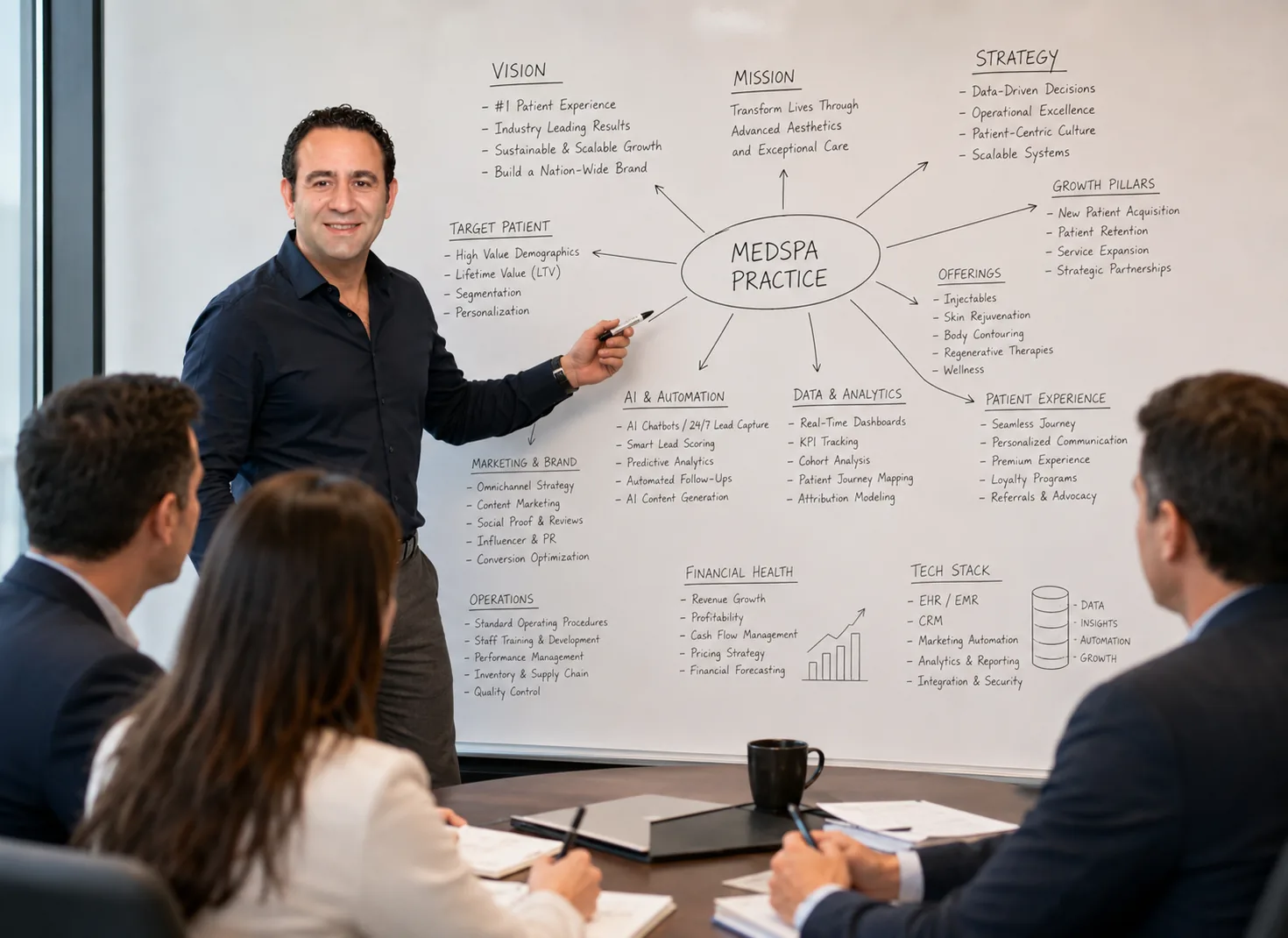
Growth is an
operational system,
not a campaign.

Sam Baba works at the intersection of medspa growth, AI, business intelligence, data systems, and strategic execution — treating every growth challenge as an engineering problem first.

Sam Baba presenting a medspa growth framework to a team
ii.
The Interaction of the Whole System
Live System Map

Pull any node and feel the whole system respond.

Drag nodes to explore connections. Swipe empty space to pan, and pinch or use the built-in controls when you want to zoom.

Seven domains. Fifty-three nodes. Twenty-nine cross-domain connections. This is not a diagram — it is a working model of how a medspa operates as a single, interdependent system.

Every part of a medspa is in constant conversation with every other part.

A consult close rate that drops is rarely a sales problem. A scheduling gap is rarely just an ops problem. This live system map makes the second-order connections between strategy, marketing, sales, operations, finance, intelligence, and compliance readable at a glance.

Why this matters

Problems don't start where they surface.

A weak consult close rate can start in positioning. A schedule problem can begin in demand pacing. A lead-quality complaint can actually be an offer, response, or follow-up problem. This view makes those second-order relationships visible before any intervention is designed.

Strategy ↔ Demand quality Inquiry ↔ Scheduling Pricing ↔ Profitability CRM ↔ Follow-up Claims ↔ Brand trust Visibility ↔ Decision quality
01

Symptoms travel.

What shows up as a front-desk or marketing complaint often starts upstream in structure, positioning, or handoff design.

02

Handoffs compound.

Small losses between inquiry, consult, scheduling, treatment, and recall become visible only when the business is read as one connected system.

03

Clarity changes action.

Once the owner can see how pressure moves across the practice, the next move becomes more precise and less reactive.

i. The Philosophy

Not a marketing
problem. An operational one.

The focus is not simply on generating more leads or implementing isolated tactics. It is on understanding how every moving part inside a medspa practice interacts — marketing, operations, finance, patient experience, staff performance, workflows, technology, reporting, and decision-making.

As practices scale, complexity increases, visibility decreases, bottlenecks emerge, and owner dependency often becomes one of the largest growth constraints.

With a strong background in systems thinking, process architecture, analytics, and operational visibility, the work centers on identifying friction points, operational inefficiencies, scalability barriers, and hidden bottlenecks that limit growth.

ii. Core Focus Areas

Where the work
actually lives.

01

Medspa Growth & Operational Intelligence

Diagnosing the real growth constraint — whether it lives in marketing, operations, staff capacity, pricing, or patient experience — and designing the system-level response.

Growth Architecture Constraint Analysis Owner Independence
02

AI & Automation Infrastructure

AI, automation, and workflow design are treated as core operational assets — not secondary tools. Building the infrastructure that makes practices faster, smarter, and less dependent on manual effort.

AI Systems Workflow Design Automation
03

Business Intelligence & Data Systems

Data infrastructure and business intelligence that give owners and operators real visibility into what is actually happening inside the practice — not just what looks good on a report.

Data Architecture BI Dashboards KPI Design
04

Operational Visibility & Decision Architecture

Eliminating the invisible labor and guesswork that slows decision-making. Building reporting rhythms, decision frameworks, and visibility layers so the right information reaches the right person at the right time.

Reporting Systems Decision Frameworks Visibility Layers
05

Scalability & Bottleneck Removal

Identifying the friction points, handoff failures, and structural inefficiencies that cap growth — and rebuilding those systems so the practice can scale without adding chaos.

Bottleneck Analysis Process Design Scale Readiness
06

Strategic Execution & System Design

Translating high-level strategy into concrete, sequenced operational changes. Designing adaptive systems capable of supporting sustainable growth, stronger execution, and reduced operational chaos as the business evolves.

Roadmap Design Adaptive Systems Execution Architecture
iii. The Approach

Engineering thinking.
Applied to growth.

The approach is heavily influenced by engineering and manufacturing thinking — where every variable is understood, every bottleneck is mapped, and every intervention is sequenced for maximum leverage.

Step I

Diagnose the real constraint

Before any tactics are proposed, the actual constraint is identified. Not the obvious surface problem — the deeper structural issue that is limiting growth, visibility, or owner freedom.

Step II

Map the whole system

Marketing, operations, finance, patient journey, staff performance, workflows, technology, and reporting are mapped together — because that is how they actually interact inside a practice.

Step III

Build the intelligence layer

AI, data infrastructure, automation, and decision visibility are layered in as operational assets — reducing chaos, enabling faster decisions, and removing the invisible labor that compounds over time.

Step IV

Sequence for adaptive growth

Instead of a static plan, practices are built to adapt — with systems that improve as the business evolves, and a roadmap sequenced so each move earns the capacity for the next.

iv. Core Convictions
  • 1.

    Owner dependency is a structural problem. Not a motivation problem. Systems must be designed to reduce it systematically.

  • 2.

    Complexity is predictable. As a practice scales, invisible labor, bottlenecks, and decision overload follow the same patterns. The interventions are knowable.

  • 3.

    Visibility is a growth lever. Practices that can see clearly — across marketing, operations, and finance — make better decisions faster and compound their advantage over time.

  • 4.

    AI is infrastructure, not a shortcut. Implemented correctly it reduces chaos, surfaces insights, and extends what a small high-performing team can execute.

  • 5.

    Sustainable growth is designed, not stumbled into. Adaptive systems outperform reactive ones — always, and especially when growth accelerates.

Building practices that are intelligent, scalable, and measurable.

The objective is to help medspa practices become more intelligent, scalable, measurable, and operationally structured. Instead of building static businesses that constantly react to problems, the focus is on building adaptive systems capable of supporting sustainable growth.

Stronger execution, clearer decision-making, and reduced operational chaos as the business evolves — not as a byproduct of working harder, but as the direct result of building better systems.

Request an introductory call
Let's talk

Start with an introductory call.

Tell me about your practice and what you're trying to solve. I'll read your message before we speak — no intake questionnaire, just context.

Sam reviews every request personally.